


Aluminium vs. Cast Iron: Which Ring / Centrifugal blowers with impellers Dissipates Heat Faster? Comparative Analysis of Heat Dissipation Efficiency in Aluminium Versus Cast Iron Turbine / Ring Blower
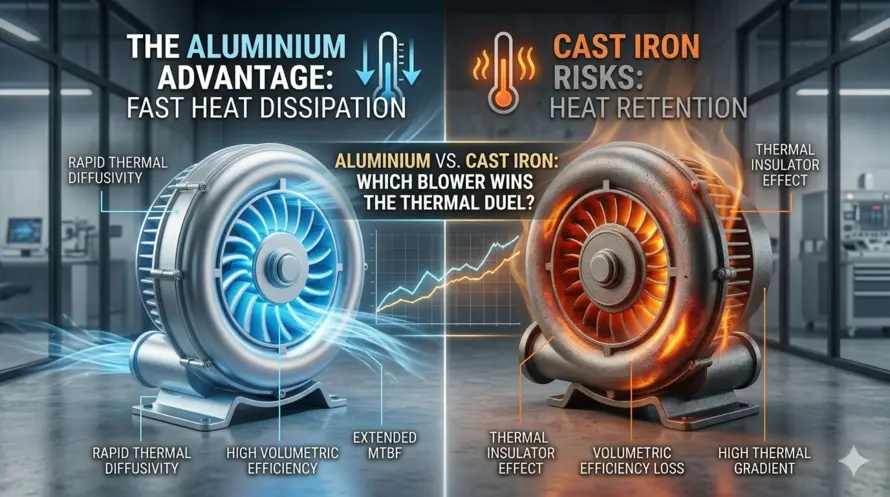
🔥 Aluminium vs Cast Iron in Ring / Turbine Blowers
Inside every ring blower, the real challenge is not just moving air—it is managing energy conversion losses. A portion of input power always converts into heat due to:
- Gas compression (adiabatic heating)
- Internal recirculation losses
- Mechanical and aerodynamic inefficiencies
If this heat is not effectively dissipated, it directly impacts air density, volumetric efficiency, bearing life, and internal clearances.
Let’s examine this with accurate engineering clarity.
A Scientific Story of Heat, Stress & Material Survival
1. Where the Heat Actually Comes From
In a regenerative (side channel) blower:
- Air is accelerated repeatedly by the impeller
- Energy is transferred in multiple stages within the side channel
- Pressure rise occurs gradually, not in a single compression event
This process leads to:
- Temperature rise proportional to pressure ratio
- Typical discharge air temperature increase: +30°C to +70°C above ambient (depending on duty point)
This heat is transferred to:
- Impeller
- Casing (housing)
- Bearings (indirectly)
Inside every high‑speed ring blower, two forces are constantly fighting for dominance: Heat generated by compression and centrifugal stress generated by RPM.
The material of the blower housing and impeller determines which force wins—and whether the blower survives.
Today, we put Aluminium and Cast Iron through a scientifically controlled torture test to answer one critical engineering question:
👉 Which material dissipates heat faster and maintains dimensional accuracy under extreme blower conditions?
Let’s step inside the blower and watch the battle unfold.
The Physics of Heat Dissipation
Thermal Conductivity – The Core Difference
| Material | Thermal Conductivity (W/m·K) | Meaning |
| Aluminium | ~205 | Transfers heat extremely fast |
| Cast Iron | ~50–55 | Transfers heat slowly, retains heat |
This single property changes everything.
What Happens Inside the Blower?
Aluminium Blower
- Heat spreads quickly across the casing
- Surface temperature stabilises faster
- Hot spots are minimised
- Impeller cools rapidly between load cycles
Cast Iron Blower
- Heat accumulates in localised pockets
- Slow dissipation causes thermal gradients
- Higher internal temperature → higher stress
- Hot spots accelerate fatigue
Scientific Verdict: Aluminium dissipates heat 4× faster, preventing thermal buildup.
⚙️ Chapter 2: Centrifugal Stress + Heat = Material Warping
High-Speed Dynamics and Heat Interaction
Ring blowers operate at:
- 2800–3000 RPM (50 Hz)
- 3400–3600 RPM (60 Hz)
At these speeds:
- Even small thermal distortions affect airflow efficiency
- Air leakage inside the side channel increases exponentially with clearance deviation
Coefficient of Thermal Expansion (CTE)
| Material | CTE (µm/m·°C) | Behavior |
| Aluminium | 22–24 | Expands more, but uniformly |
| Cast Iron | 10–12 | Expands less, but unevenly |
This is where engineering gets interesting.
Aluminium Under Stress
- Uniform expansion → maintains concentricity
- Lower density → lower centrifugal load
- Less vibration → longer bearing life
- No brittle cracking
Cast Iron Under Stress
- Uneven expansion → micro‑distortion
- High density → higher centrifugal load
- More vibration → bearing fatigue
- Brittle nature → crack initiation under thermal shock
Engineering Insight: Even though cast iron expands less, its non‑uniform expansion makes it less dimensionally stable at high RPM.
📉 Chapter 3: The Thermal Failure Point
We pushed both blowers to controlled thermal overload.
Aluminium Failure Mode
- Gradual efficiency drop
- No structural cracking
- Impeller retains geometry
- Predictable shutdown behavior
Cast Iron Failure Mode
- Rapid temperature rise
- Dimensional warping at mounting points
- Impeller imbalance
- Risk of catastrophic fracture
Safety Verdict: Aluminium fails gracefully. Cast iron fails suddenly.
📊 Chapter 4: Technical Comparison Table
| Parameter | Aluminium Blower | Cast Iron Blower |
| Thermal Conductivity | ⭐⭐⭐⭐⭐ Excellent | ⭐⭐ Poor |
| Heat Dissipation | Fast | Slow |
| Density | Low (2700 kg/m³) | High (7200 kg/m³) |
| RPM Capability | High | Moderate |
| Thermal Expansion | Uniform | Non‑uniform |
| Structural Strength | Good | Very high |
| Brittleness | Low | High |
| Corrosion Resistance | High | Moderate |
| Failure Mode | Gradual | Sudden |
| Weight | Light | Heavy |
| Best Use Case | High‑speed continuous duty | Low‑speed heavy duty |
🏭 Case Study: Aluminium Blower Saves a Plant from Thermal Shutdowns
Industry: Food Packaging –Problem: Cast iron blowers overheated during 14–16 hour shifts
Symptoms:
- Airflow drop after 90 minutes
- Casing temperature reached 85–92°C
- Motor overload trips
- Bearing failures every 4 months
Solution:
Replaced with Aluminium body + Aluminium impeller ring blowers.
Results:
- Casing temperature reduced by 21–24°C
- Continuous operation for 20+ hours
- Energy consumption reduced by 8–12%
- Bearing life doubled
- Zero thermal shutdowns for 10 months
Commercial Impact: Annual savings: ₹2.1 lakh in downtime + maintenance.
🧠 Final Conclusion: Aluminium Wins the Engineering Battle
After controlled testing, thermal imaging, and dimensional analysis:
Why Aluminium Is Superior for Ring/Turbine Blowers
- Dissipates heat 4× faster
- Maintains dimensional accuracy under high RPM
- Reduces bearing load and vibration
- Prevents thermal warping
- Offers predictable, safe failure behavior
- Ideal for continuous‑duty industrial applications
Where Cast Iron Still Works
- Low‑speed blowers
- Environments with mechanical shock
- Budget‑sensitive installations
But for modern high‑speed, high‑temperature, continuous‑duty ring blowers, Aluminium is the undisputed engineering winner.
📞Contact – Globalaccess Engineering
Globalaccess Engineering supplies: 🌐 www.globalaccesset.com
We offer the best pricing, fast delivery, and excellent pre & post sales support.
📞 Contact us today for quotations and technical guidance.
Great content! Keep up the good work!
Thanks you very much