


Ring Blower vs. Roots Blower – Which One Should You Choose?
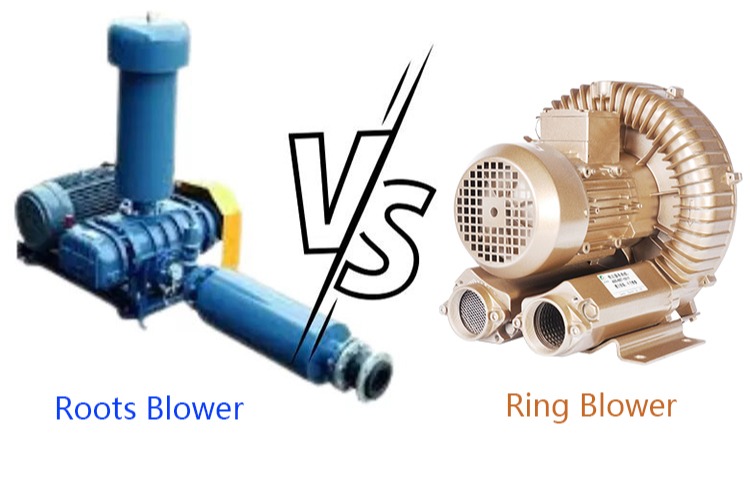
In industrial air handling, two common choices stand out — Ring Blowers and Roots Blowers. While both are designed to move air or gas for various applications, their working principles, performance characteristics, and maintenance requirements differ significantly.
This guide provides a technical comparison to help you make the right decision.
How They Work
Ring Blower (Regenerative Blower)
A ring blower uses a non-contact impeller and a regenerative air channel to create pressure. As air circulates through the side channels multiple times, pressure builds up steadily, producing a pulsation-free airflow.
Typical Applications: Wastewater aeration, pneumatic conveying, vacuum lifting, aquaculture aeration, packaging machinery.
Roots Blower
A Roots blower uses two counter-rotating lobes to trap and move air from the inlet to the outlet. It produces higher volumes of air at relatively low pressures, but with more pulsation and vibration.
Typical Applications: Bulk material handling, combustion air supply, sewage treatment, large-scale pneumatic conveying.
Technical Comparison Table
| Feature / Parameter | Ring Blower | Roots Blower |
|---|---|---|
| Working Principle | Regenerative side channel | Positive displacement (lobe type) |
| Pressure Range | Up to ~500 mbar | Up to ~1 bar |
| Airflow Quality | Steady, pulsation-free | Pulsating flow |
| Noise Level | Low (typically 50–75 dB) | Higher (typically 80–100 dB) |
| Lubrication | Oil-free | Requires lubrication |
| Maintenance | Low (few moving parts) | Moderate to high |
| Durability | High – minimal wear | High – but mechanical parts wear faster |
| Energy Efficiency | High efficiency motors | Slightly less efficient at lower loads |
| Heat Generation | Low | Higher (requires cooling in long runs) |
| Size & Weight | Compact and lightweight | Larger and heavier |
| Cost | Moderate | Higher initial and maintenance cost |
| Vibration | Minimal | Noticeable, requires vibration isolation |
| Best For | Continuous low-to-medium pressure tasks | High-volume, low-pressure bulk applications |
Pros & Cons
Ring Blower
Pros:
- Oil-free, clean air output
- Low noise and vibration
- Compact size and easy installation
- Low maintenance requirements
- Energy efficient
- Long service life
Cons:
- Lower maximum pressure compared to Roots blower
- Not ideal for very high flow rates
Roots Blower
Pros:
- Can handle large volumes of air
- Capable of higher pressures than ring blowers
- Strong and rugged design for heavy-duty tasks
Cons:
- Requires regular lubrication and maintenance
- Noisier operation with pulsation
- Higher power consumption in many cases
- Bulkier and heavier
Conclusion – Why Ring Blower Wins
For most industrial, laboratory, and light-to-medium-duty applications, the Ring Blower is the more practical choice. Its oil-free operation, energy efficiency, and low maintenance make it ideal for businesses that value reliability and cost savings over time.
While Roots blowers still have their place in very high-volume, low-pressure applications, most industries can achieve better performance, lower noise, and reduced operational costs by choosing a Ring Blower.
Recommendation:
For wastewater treatment, pneumatic conveying, aquaculture aeration, and vacuum applications, choose a Ring Blower from a trusted Supplier like us.