


Precision Measurement with Granite Surface Plates and Height Gauges: Techniques, Care, and Case Insights
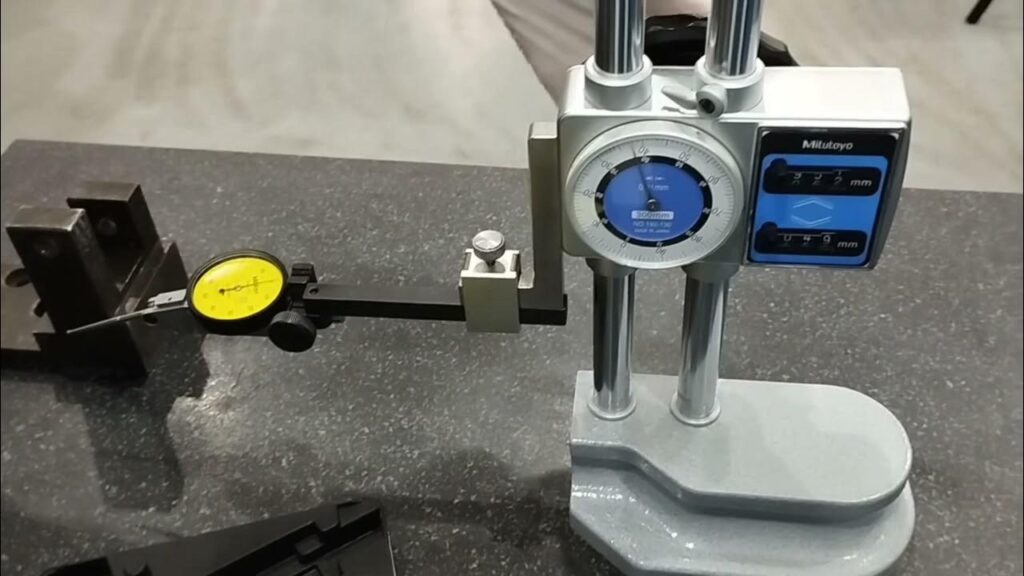
Granite surface plates and height gauges form the backbone of dimensional metrology in manufacturing, machining, and quality control. Their synergy enables accurate vertical measurements, layout marking, and calibration tasks. This blog explores their working principles, handling techniques, and real-world applications, with service recommendations to maintain long-term accuracy.
🧱 Granite Surface Plate: The Foundation of Flatness
A granite surface plate is a finely lapped, ultra-flat reference surface used to inspect flatness, straightness, and parallelism. Made from black granite due to its low porosity, high stiffness, and resistance to corrosion, it offers thermal stability and minimal wear over time.
🔍 Key Features:
- Flatness tolerance: Typically within 3–5 µm/m depending on grade (AA, A, B).
- Material: Black granite with high quartz content for wear resistance.
- Applications: Calibration, layout marking, centering, and precision assembly.
⚙️ Installation & Levelling:
- Place on vibration-isolated stands with three-point support.
- Use a precision level to ensure horizontal alignment.
- Avoid direct sunlight or heat sources to prevent thermal distortion.
📏 Height Gauge: Vertical Precision Tool
Height gauges are used to measure vertical distances from the granite surface. They come in vernier, dial, and digital variants, often equipped with scribers or dial indicators.
🧰 Measuring Technique:
- Clean the surface plate with a lint-free cloth and isopropyl alcohol.
- Zero the gauge on a reference block or master gauge.
- Place the workpiece flat on the surface plate.
- Slide the gauge gently to the measurement point.
- Read the dial or digital display without parallax error.
⚠️ Handling Instructions:
- Always lift the gauge from its base, not the column.
- Avoid dragging across the granite surface.
- Store in a dust-free cabinet after use.
- Calibrate periodically using certified gauge blocks.
🧪 Case Study: Precision in Pump Housing Inspection
Client: A wastewater treatment OEM in Coimbatore Challenge: Ensuring concentricity and height uniformity of pump housing flanges Solution:
- Used a Grade A granite surface plate (600×600 mm)
- Employed a Mitutoyo dial height gauge with 0.01 mm resolution
- Verified flange height at four points and marked deviations
- Adjusted machining process based on inspection feedback
Result: Reduced rework by 35%, improved assembly fit, and enhanced pump performance.
🛠️ Service Recommendations
| Component | Frequency | Service Type | Provider Suggestion |
|---|---|---|---|
| Granite Surface Plate | Annual | Calibration & Relapping | Michelli, Eley Metrology |
| Height Gauge | Monthly | Calibration & Lubrication | Mitutoyo, Baker Gauges |
| Dial Indicator | Quarterly | Accuracy Check & Zero Reset | Starrett, Insize |
🌐 Trusted Brands & Resources
- Mitutoyo – Precision gauges and surface plates
- Starrett – High-end dimensional tools
- Michelli Weighing & Measurement – Calibration services
- Niigata Seiki – Surface plate manuals and care guides
- The Engineer’s Post – Technical diagrams and usage tips
Conclusion: Granite surface plates and height gauges are indispensable for precision engineering. With proper technique, regular calibration, and careful handling, they ensure consistent quality and dimensional integrity across industries—from wastewater treatment to aerospace.
At Globalaccess Engineering & Technologies Pvt. Ltd., we provide not only premium-grade granite surface plates, but also expert guidance, calibration support, and long-term service plans to keep your plates in perfect shape.
📞 Contact us today to schedule a maintenance consultation or calibration service.
Since the admin of this web site is working, no question very shortly it will be well-known, due to its feature
contents.
Thank you very much for your valuable feedback.