


Precision Inside the Hole: A Complete Technical Guide to Bore Gauges
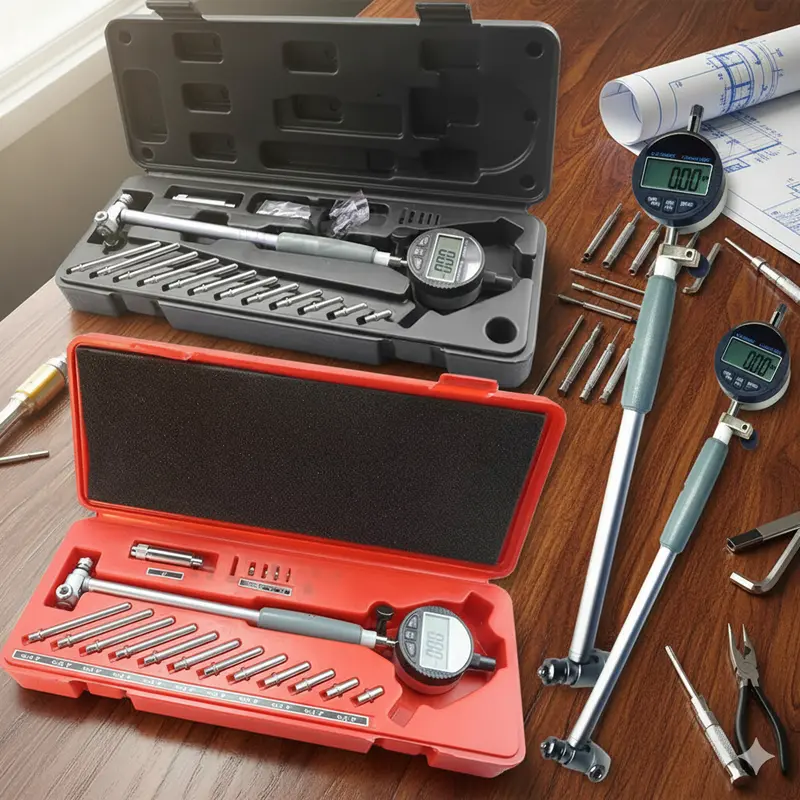
Manufacturing • Assembly • Working Principle • Testing • Case Study • Safety • Advantages
By Globalaccess Engineering – Your Trusted Partner for Quality Measuring Instruments at the Best Price
🌟 Introduction
In precision machining, even a micrometre-level deviation inside a bore can affect product performance, assembly fit, and long-term reliability. This is where Bore Gauges become indispensable. From manufacturing industries to quality labs, a bore gauge ensures that the machined hole dimensions are accurate, consistent, and within tolerance.
This blog explores how bore gauges are manufactured, assembled, calibrated, used, and tested, along with technical advantages and real-world applications—while showing why Globalaccess Engineering is your ideal partner for procuring precision measuring tools.
1. What is a Bore Gauge?
A bore gauge is a precision instrument used to measure the internal diameter (ID) of a hole, cylinder, or bore. It is widely used in:
- Automotive engines
- CNC machining
- Milling and turning operations
- Tool rooms and inspection labs
- Hydraulic cylinder manufacturers
- Calibration labs
Most commonly, we use a Dial Bore Gauge, which provides accurate, repeatable measurements up to ±0.001 mm.
2. How Bore Gauges Are Manufactured
2.1 Material Selection
High-precision bore gauges are typically manufactured using:
- Heat-treated alloy steels – for wear resistance
- Chrome-plated rods – for corrosion resistance
- Carbide-tipped contacts – for long-term dimensional stability
- Precision-ground spindles – for friction-less movement
2.2 CNC Machining
The internal components must be extremely accurate. Parts are manufactured using:
- High-precision CNC turning for handles and bodies
- Cylindrical grinding machines for guide rails
- Micro-lapping for contact points
- EDM machining for high-accuracy slots
2.3 Heat Treatment
To resist wear and maintain accuracy, the components undergo:
- Hardening (HRC 55–60)
- Stress relieving
- Tempering
2.4 Precision Assembly
Components are assembled in dust-free zones. Dial indicators are calibrated and fitted with:
- Spring-loaded plungers
- Carbide measuring pins
- Extension rods and anvils
2.5 Final Calibration
Each bore gauge undergoes:
- Master ring calibration
- Repeatability test
- Zero-setting verification
3. Assembly of a Bore Gauge – Step-by-Step
- Select the extension rod based on bore size.
- Attach the correct measuring anvil to match the required measuring range.
- Fit the dial indicator into the bore gauge head.
- Tighten all components using the locking screws.
- Calibrate the gauge using a master setting ring or micrometer.
The assembly ensures the bore gauge provides accurate and repeatable measurements.
4. Working Principle of a Bore Gauge
The bore gauge uses:
3-Point or 2-Point Contact Measurement
- When the gauge is inserted into the bore, the spring-loaded plungers expand or contract based on the bore diameter.
- These movements are transferred mechanically to the dial indicator, showing deviation from the set zero.
Zero Setting
The gauge is first set to zero using a Master Ring Gauge, Slip Gauge Stack, or Outside Micrometer.
All measured values then indicate the difference from the master dimension—ensuring high accuracy.
5. Table: Bore Gauge Usage, Technical Advantages & Safety Measures
| Section | Bullet Points / Details |
| A) How to Use a Bore Gauge on a Machined Component | Step 1: Set Zero • Use a master ring gauge or micrometer. • Adjust the dial indicator to zero. Step 2: Insert into the Bore • Insert gently into the hole. • Tilt slightly until the smallest reading is obtained. • Move left-right and front-back to find the true minimum point. Step 3: Observe Dial Movement • Take the smallest value as the actual bore diameter. • Compare results with tolerance values. Step 4: Record and Document • Maintain inspection logs for auditing. • Record batch-wise or component-wise readings. |
| B) Technical Advantages of Bore Gauges | • High accuracy up to ±1 micron (0.001 mm). • Easy to use with simple tilt method. • Excellent repeatability for batch inspection. • Suitable for deep bores using extension rods. • Carbide tips ensure long tool life and wear resistance. • Faster inspection compared to CMM or air gauges. |
| C) Safety Measures While Using Bore Gauges | • Do not drop or apply shock—mechanisms may misalign. • Always perform zero-setting before every shift. • Keep away from strong magnetic fields. • Clean both bore and gauge before measurement. • Store in a padded protective box after use. • Avoid excessive force inside the bore to prevent tip damage. |
📚 6. Case Study: Improving Precision in Cylinder Block Manufacturing
Client Industry: Automotive Engine Manufacturer
Problem:
Cylinder bores in the engine block had a variation of 15 microns, causing piston ring failure.
Solution :
- Supplied high-precision 3-point dial bore gauges
- Trained machine operators on zero-setting and repeatability
- Implemented an in-process bore measurement system
Outcome:
- Bore variation reduced from 15 microns to 4 microns
- Rejection rate reduced by 72%
- Improved engine life and performance
This demonstrates how the right measuring tool can significantly increase manufacturing accuracy.
⚠️7. Important Notes
- Always use a master ring gauge for best zero-setting accuracy.
- Keep the measuring contacts free of oil and debris.
- For bores with rough surfaces, take multiple readings.
- Calibrate the bore gauge once every 6–12 months.
- Do not use worn anvils or bent extension rods.
✅ Final Suggestion
For precision machining, the bore gauge is not just a tool—it’s a quality assurance system. Choosing a reliable and accurate bore gauge directly impacts your product performance, tolerance control, and customer satisfaction.
If you want high-quality, durable, and accurate Bore Gauges at the BEST PRICE, choose a trusted supplier.
📞Contact – Globalaccess Engineering
Globalaccess Engineering supplies: 🌐 www.globalaccesset.com
- Bore Gauges
- Granite Surface Plates
- Ring Blowers
- Industrial Measuring Instruments
- Calibration Accessories
- Custom Solutions for Manufacturing Units
We offer the best pricing, fast delivery, and excellent pre- & post-sales support.
📞 Contact us today for quotations and technical guidance.
Excellent post. I was checking constantly this weblog and I’m inspired!
Very helpful information specially the closing section 🙂 I care for such information much.
I used to be looking for this certain info for a long time.
Thanks and best of luck.
Thanks for your valuable feedback.
Thanks for your valuable feedback