


🌊 Ring Blowers in Wastewater Treatment: Technical Benefits & Strategic
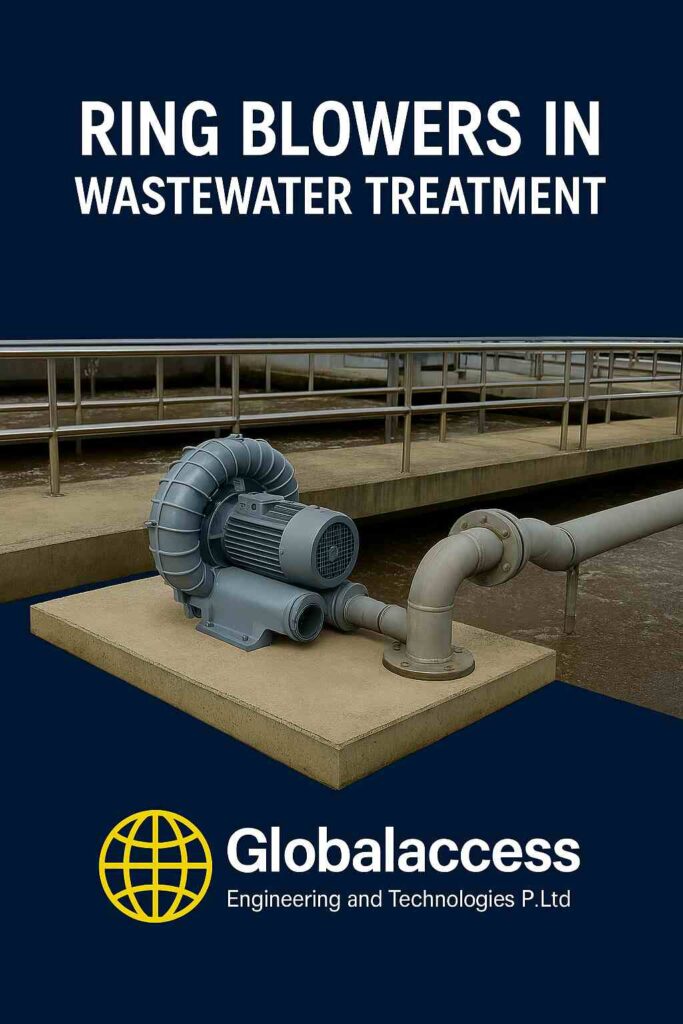
In the evolving landscape of wastewater treatment, ring blowers have emerged as a quiet powerhouse—offering energy-efficient, low-maintenance, and cost-effective aeration solutions. Whether you’re upgrading legacy systems or designing new treatment plants, understanding the technical and commercial advantages of ring blowers can unlock significant operational gains.
🔧 What Are Ring Blowers?
Ring blowers, also known as regenerative blowers or side channel blowers, generate airflow by creating pressure through a vortex inside a ring-shaped chamber. Unlike positive displacement blowers, they are oil-free, compact, and ideal for continuous low-pressure applications—making them perfect for aeration, sludge drying, and odor control in wastewater treatment.
At Globalaccess Engineering & Technologies Pvt. Ltd., we help industries evaluate the technical, commercial, and operational impact of using Ring Blowers in wastewater applications, ensuring the right solution for your plant’s efficiency and ROI.
🔹 Technical Benefits of Ring Blowers in Wastewater Treatment
- Oil-Free, Clean Air Supply
- Ring blowers deliver 100% oil-free air, preventing contamination of treated water.
- Continuous Duty Cycle
- Designed for 24/7 operation, ideal for wastewater aeration which requires constant airflow.
- Low Noise and Vibration
- Operates quietly compared to conventional compressors, improving operator comfort.
- Durability & Maintenance
- Few moving parts, leading to long service life and minimal maintenance.
- Energy Efficiency
- Consumes 20–30% less power compared to some traditional compressor systems.
- Flexibility
- Available in single-stage and double-stage designs for varying pressure and flow needs.
🔹 Merits & Demerits of Using Ring Blowers in Wastewater
| Aspect | Merits | Demerits |
| Air Quality | Delivers oil-free air, ensuring water purity | Not suitable for extremely high-pressure applications |
| Operation | Continuous duty cycle; ideal for 24/7 aeration | Efficiency decreases at very high back pressure |
| Maintenance | Low maintenance, simple design | Impeller wear over time requires replacement |
| Noise & Vibration | Quiet operation compared to compressors | Higher noise at very high speeds |
| Energy Efficiency | Consumes less energy than many alternatives | Efficiency varies with system design |
| Cost | Lower lifecycle cost, fewer breakdowns | Higher initial investment vs small air pumps |
📊 Expanded Statistical Benefits of Ring Blowers in Wastewater Treatment
1. Energy Efficiency & Cost Reduction
- 💡 Up to 30–40% lower energy consumption compared to traditional positive displacement blowers
- 💰 Annual savings of ₹4.4 to ₹13.2 lakhs per blower unit in mid-sized plants, depending on runtime and local energy tariffs
- ⚡ Specific Energy Consumption (SEC): Ring blowers average around 0.5–0.7 kWh/m³ of air delivered, compared to 1.0+ kWh/m³ for older technologies
2. Maintenance & Downtime Metrics
- 🔧 Mean Time Between Failures (MTBF): Often exceeds 20,000 hours, thanks to oil-free and frictionless design
- 🛠️ Maintenance cost reduction: Estimated 40–60% lower over 5 years due to fewer moving parts and no lubrication systems
- ⏱️ Downtime: Reduced by 25–40%, ensuring more consistent aeration and biological treatment
3. Operational Reliability
- 📈 Reliability Index: Studies using semi-Markov models show ring blowers outperform traditional blowers in uptime and fault tolerance
- 🔄 Consistent Airflow: Maintains stable pressure and flow even under variable load conditions, improving biological process efficiency
4. Environmental & Regulatory Compliance
- 🌱 Noise Emission: Typically <70 dB, helping facilities meet urban noise regulations and improve worker comfort
- 🧪 Air Quality: Oil-free operation eliminates risk of hydrocarbon contamination in aeration tanks, supporting ISO 14001 and other environmental standards
🔹 Commercial Considerations
- Initial Investment: Slightly higher than small pumps but lower than large compressors.
- Operating Cost: Lower due to energy efficiency and reduced downtime.
- Service Life: Typically 8–12 years with routine checks.
- ROI: Savings on maintenance and reduced rework usually offset cost within 1–2 years.
📌 Case Study: Ring Blowers in a Municipal Wastewater Plant
A municipal wastewater treatment plant in South India faced rising energy costs and frequent breakdowns using traditional compressors. Their aeration process was inconsistent, leading to poor BOD (Biological Oxygen Demand) reduction.
After installing Double-Stage Ring Blowers in 2022:
- Oxygen levels in aeration tanks increased by 18%, improving treatment quality.
- Annual energy costs dropped by ₹4.5 lakhs due to higher efficiency.
- Equipment downtime was reduced by 45%, ensuring compliance with environmental standards.
- ROI was achieved within 14 months.
✅ Outcome: Ring blowers proved to be a cost-effective, reliable, and sustainable solution for wastewater treatment aeration.
🔹 Final Recommendation
For wastewater treatment plants, Ring Blowers provide the perfect balance of technical reliability, commercial efficiency, and long-term ROI. They ensure clean air, continuous duty, and energy savings, making them a superior alternative to conventional compressors and pumps in most wastewater setups.
📖 Read More Technical Insights Here →
📞 Contact Globalaccess Engineering & Technologies Pvt. Ltd. for a custom blower selection guide suited to your wastewater treatment needs.